Why AI Security Is Opinion and Why Olympix Guarantees Correctness
Introduction
Some classes of problems cannot be solved by better reasoning, larger models, or more data — regardless of how advanced AI becomes.
Guaranteeing correctness in high-risk, adversarial systems is one of them.
In these systems, security is not about predicting likely failures or surfacing suspicious patterns. It is about proving that explicit properties always hold, under all possible executions.
This essay explains why reasoning and learning alone cannot produce such guarantees, why deterministic execution is required, and why any AI system that aims to offer guarantees must ultimately rely on infrastructure like Olympix rather than replace it.
Explanation
1. Security Requires Correctness Guarantees
There is a single source of truth about whether a system is correct: the invariants that must hold across all possible executions.
The problem is that humans can only define a very small, high-level subset of those invariants.
These are the invariants stakeholders already know and care about. They come from outside the system and express intent: what must never happen. They are intentionally defined by companies, risk owners, or regulators. Examples include:
the system must not be exploitable
assets must not be misused or lost
only authorized actors may perform sensitive actions
These invariants are real and necessary — but they are only the top layer.
The vast majority of invariants that actually determine correctness live below this level. They are implicit, emergent constraints that govern how those high-level invariants can be violated across the system’s full execution space. They do not exist ahead of time. They are not written down, not obvious from code, and cannot be fully listed or identified just by looking at the code. They are not statements of intent — they are structural facts about how the system behaves when intent is stressed, combined with other parts or systems, or attacked.
Humans cannot enumerate these invariants. AI cannot either.
AI may have access to the high-level intent invariants, but it cannot derive the unbounded set of execution-level invariants beneath them. Instead, AI “models intent” — it guesses how the system is supposed to behave based on code patterns, comments, naming, and similar systems it has seen. This is opinion. While many correct invariants may be guessed this way, the resulting set can never be exhaustive.
There is no objective signal that says:
“Yes, this is the complete set of invariants that must always hold.”
Without completeness, correctness is undefined. And therefore cannot be guaranteed.
This limitation does not disappear with scale. Fine-tuned models and larger datasets do not change the nature of the problem. As an example, in the digital asset ecosystem, public exploit data is abundant - but it is not ground truth: exploit labels describe observed failures, not the full execution space in which failures could occur. Learning from outcomes improves pattern matching, not exhaustiveness.
Olympix does not solve this by “guessing better.” It starts from the small set of high-level invariants humans can define and assumes responsibility for the unbounded remainder — discovering, validating, and enforcing the full invariant space through deterministic execution. AI can help articulate intent, but only a deterministic engine can enforce invariants across all relevant executions.
2. Correctness Guarantees Require a Complete & Precise Spec
Even when some correctness properties are explicitly defined, verifying them still requires a complete, machine-checkable specification of system-wide behavior.
To mathematically verify a system exhaustively, you need:
Together, these form a complete and accurate security spec.
AI does not derive these mathematically - it guesses them. AI operates on natural language and pattern recognition.
It starts by asking:
“What does this code seem like it’s trying to do?”
Even if AI then generates a spec, that spec is still:
incomplete (it misses edge cases)
ambiguous (natural language does not map cleanly to logic)
unverified (there is no proof it matches actual behavior)
As a result, any proof built on that specification is only as reliable as the guessed spec. That is still opinion.
In safety-critical systems, an incomplete specification is not partially correct — it is incorrect. Missing even a single invariant invalidates the guarantee.
Olympix starts from a different question:
“What does this code actually do?”
That is behavior calculus — fact, not interpretation.
The guarantee does not come from how a spec is proposed. It comes from whether the spec is complete and whether every reachable execution is exhaustively verified against it.
That burden is carried by the deterministic engine, not the model.
No amount of intelligence can sit down and “think” through security exhaustively.
To reason from first principles, you need:
a closed system
known laws
known objectives
known constraints
Security has none of these. Clear, exact first principles do not exist ahead of time for an AI to reason over.
Exploits are:
emergent
adversarial
context-dependent
shaped by human incentives
shaped by tooling constraints
shaped by language semantics
shaped by economics, governance, and deployment patterns
There is no universal rulebook. The combinatorial space of possible behaviors is too large to reason through exhaustively.
In practice, reasoning would require deciding:
which taint propagation graph depth is predictive (how far a user-controlled change must ripple before it becomes dangerous)
which divergence thresholds matter (how much behavior must drift (and before it signals a real vulnerability)
which state asymmetries correlate with real exploits (which imbalances attackers can actually exploit)
Reasoning requires priors — known rules, known objectives, and known constraints. But in security, the “rules” emerge from adversarial behavior, objectives change with incentives, and constraints depend on language semantics, tooling, and economics.
An AI reasoning system would have to imagine all possible signals then rank them, and decide which matter — without any ground truth to rank against.
This is the crux of what Olympix does differently, and why we are the first to automate formal methods at this level and commercialize them.
To exhaustively test this combinatorial space without exploding complexity, Olympix discovers the correct signals — measurable patterns that reveal where danger actually lives inside an otherwise enormous space of possible behaviors.
These signals enable the Olympix engine to decide which execution paths must be traversed and which can be safely ignored.
The number of possible signals is infinite. AI cannot reason its way through infinite hypothesis space.
Signals can only be discovered empirically by:
running a deterministic engine
observing millions of executions
measuring outcomes
correlating measurements with real vulnerabilities
locking those measurements into the engine
This process is closer to physics than reasoning.
Physics didn’t start with equations. It started with dropping objects, measuring motion, observing repeatable patterns, and encoding those patterns into laws. No amount of reasoning could have derived gravity without observation and the correct tests.
Once these signals are learned, the Olympix engine applies bounding, abstraction, and symbolic execution to intelligently select which execution paths must be traversed, and which can safely be ignored – while preserving guarantees.
4. Correctness Guarantees Require Proof
Olympix does not produce probabilistic findings or heuristic alerts. It produces deterministic proof artifacts.
First, on path exploration: Olympix’s guarantees do not come from exploring “likely” execution paths or prioritizing risk by probability. They come from proving which behaviors can and cannot affect a specified property — and excluding paths only when the engine can mathematically show they are irrelevant.
Then, for the paths that are relevant, every finding from Olympix results in one of two outcomes:
a machine-checkable proof that a property holds under all reachable executions, or
a concrete counterexample showing how the system can be exploited.
the exact state transitions that lead to failure, and
the minimal conditions required to trigger the exploit.
This is why Olympix ensures zero false positives. Findings are not based on suspicion, interpretation, or pattern matching — they are backed by executable evidence.
AI-driven security tools may surface potential issues or suggestions, but they cannot guarantee correctness because they do not enumerate all relevant reachable states or produce verifiable proof artifacts. Olympix does.
Without a deterministic engine, AI-driven exploration is open-ended. Olympix is the termination layer — the point where exploration collapses into proof or counterexample.
5. What Olympix Actually Does
Step 1: Humans set the highest level goals/requirements
Humans do not define systems in terms of execution paths, state transitions, or invariant completeness. They define intent.
That intent takes the form of high-level goals and constraints, such as:
the system must not be exploitable
the system must comply with regulatory and legal requirements
the system must adhere to internal risk, safety, and governance standards
These statements are necessary, but they are not sufficient to guarantee correctness.
They describe what outcomes are unacceptable, not how those outcomes could arise. Translating intent into the full set of behavioral conditions required to uphold it is not something humans can do reliably — even in principle.
This is not a tooling limitation or a skill gap. The behavioral space beneath a single intent-level requirement is unbounded, adversarial, and emergent. Most real-world exploits occur in systems that satisfied every explicitly stated rule.
Olympix does not attempt to replace human intent. It takes that intent as input — and assumes responsibility for everything humans cannot do beneath it.
Step 2: Olympix determines how to verify them exhaustively
This is the hard part no one else has solved.
To do that, Olympix must discover:
which behaviors can affect those properties
which paths are irrelevant
which asymmetries matter
which measurements predict violations
These are the signals. These signals are not the properties themselves — they are the engine’s learned understanding of the behavioral space needed to enforce them.
Step 3: Olympix enforces the properties deterministically
Using:
state models
Code abstractions like CFGs
bounding
abstraction
symbolic execution
proof artifacts
This produces:
proof that the property holds, or
a concrete exploit trace
6. How We Use AI (and Why It Stays Upstream)
Olympix is not anti-AI. It is built to use AI where it is genuinely strong — while refusing to delegate correctness to probabilistic systems.
AI excels at hypothesis generation, search guidance, and complexity reduction. Olympix uses AI precisely in these roles.
Where AI Adds Value
Within the Olympix engine, AI is used to:
Propose candidate invariants and properties to reduce human effort
Prioritize and guide execution-path exploration in large state spaces
Suggest abstractions and pruning opportunities, subject to proof
Accelerate invariant discovery and coverage expansion
Solve paths that are not SMT solvable
In short: AI expands the reach of the engine.
What AI Is Never Allowed to Do
AI is never allowed to:
Define correctness
Certify completeness
Suppress execution paths without proof
Produce final security conclusions
AI can propose. The engine is the final authority that decides whether something is actually safe or actually broken — by proof, not opinion.
Why This Boundary Matters
AI produces heuristics. Guarantees are binary.
A single missed behavior invalidates a guarantee. There is no graceful degradation. This is why Olympix keeps AI upstream — as an accelerator, not an authority.
Without a deterministic execution model, sound abstractions, and machine-checkable proof artifacts, AI-guided exploration cannot terminate in proof. It can surface signals, but it cannot decide correctness.
Olympix is the termination layer.
AI makes exhaustive verification tractable. Olympix makes it exact.
AI improves speed and coverage. Olympix enforces correctness.
That is why AI systems that aim to offer guarantees will not replace Olympix — they will rely on it.
7. Why AI Can’t Just Build This
A natural question follows from the discussion above: If AI models are improving so quickly, why can’t a large AI company simply build this?
As discussed earlier, more data and better models improve pattern recognition — not exhaustiveness. They do not establish ground truth, and they do not produce guarantees. That limitation does not disappear with scale.
What makes Olympix work is not access to more data or more compute. It is the tight, irreducible coupling between three components:
a deterministic symbolic execution engine that can soundly explore system behavior
machine-checkable proof artifacts that terminate exploration into guarantees
These components must be designed together, from the ground up. They must be rich enough to provide accurate signal mappings so that the subject codebase decomposes correctly.
A general-purpose AI model — no matter how capable — operates above execution. It reasons about descriptions of code, it does not execute the actual step-by-step behavior of the system as it runs.
Olympix operates at execution: at the level of state transitions, constraints, invariants, and execution traces. It models what actually happens step by step as the code runs.
Even if an AI system could propose invariants, rank paths, or guide exploration, it would still require:
a sound execution model
a correctness-preserving abstraction layer
a proof system that can certify outcomes
Without those, the system cannot produce guarantees — only opinions.
Building that engine is not something models converge to with scale. It requires a deterministic execution layer that operates at state transitions and constraints, discovers signals through execution, and collapses behavior into verifiable proof artifacts.
The moat, therefore, is not data volume or model size, but empirically grounded execution knowledge.
That is why AI convergence does not eliminate Olympix. It makes Olympix inevitable.
8. The Compounding Advantage (The Moat)
What compounds inside Olympix is not:
“this code is bad”
“this looks suspicious”
“this is probably a vulnerability”
These are the kinds of probabilistic judgments AI systems accumulate to grow their training data — but as discussed above, more examples and better pattern matching do not turn opinions into guarantees or solve the verifiability problem.
What compounds is the engine’s understanding of:
what to measure
where to measure it
which asymmetries matter
which signals matter
which divergences predict real exploits
Technical examples:
taint propagation at specific abstraction layers
execution-path divergence after N similar paths
discriminants that surface invariant violations
mutation metrics that correlate with exploitability
This understanding is used to enforce correctness against the explicit properties from outside of the engine.
Every time a new customer uses Olympix, the engine gets stronger.
Olympix learns, empirically, from real systems:
New invariants (rules that must always hold)
New exploit patterns
New mutation patterns
New code paths and state transitions
New multi-contract interactions and failure modes
New questions to ask
New signal-vulnerability correlates
This knowledge cannot be learned from exploits, code access, or training data — regardless of scale.
It is only acquired by repeatedly executing real systems, confronting combinatorial explosion, and empirically discovering which signals actually matter.
Olympix has already discovered, validated, and hard-wired a substantial portion of these signals by running real production systems – software that is actually live, handling real users, real money, and real consequences, not test code or demos.
As the Olympix engine is applied across more companies, verticals, and real-world scenarios, it encodes these signals at the state-machine level — strengthening the engine for any system, from smart contracts to autonomous agents.
This is not a head start that shrinks — it is one that grows.
9. Why This Means Olympix Becomes Unavoidable
At this point, the technical conclusion is clear: correctness requires determinism. Determinism requires an execution model, discovered signals, exhaustive exploration, and proofs. AI can’t generate any of those; it can only guess at patterns.
Which is why AI can’t produce guarantees, but Olympix can.
Once a system needs binary correctness, the stack converges:
AI runs above, Olympix runs below.
AI reasons; Olympix proves.
AI scales patterns; Olympix enforces truth.
That’s why AI doesn’t replace Olympix. It becomes a user of Olympix.
And that’s why Olympix becomes the unavoidable verification layer for any system that needs deterministic, state-machine-level guarantees — from digital assets to autonomous workflows.
What’s a Rich Text element?
The rich text element allows you to create and format headings, paragraphs, blockquotes, images, and video all in one place instead of having to add and format them individually. Just double-click and easily create content.
A rich text element can be used with static or dynamic content. For static content, just drop it into any page and begin editing. For dynamic content, add a rich text field to any collection and then connect a rich text element to that field in the settings panel. Voila!
Headings, paragraphs, blockquotes, figures, images, and figure captions can all be styled after a class is added to the rich text element using the "When inside of" nested selector system.
Follow-up: Conduct a follow-up review to ensure that the remediation steps were effective and that the smart contract is now secure.
Follow-up: Conduct a follow-up review to ensure that the remediation steps were effective and that the smart contract is now secure.
In Brief
Remitano suffered a $2.7M loss due to a private key compromise.
GAMBL’s recommendation system was exploited.
DAppSocial lost $530K due to a logic vulnerability.
Rocketswap’s private keys were inadvertently deployed on the server.
Hacks
Hacks Analysis
Huobi | Amount Lost: $8M
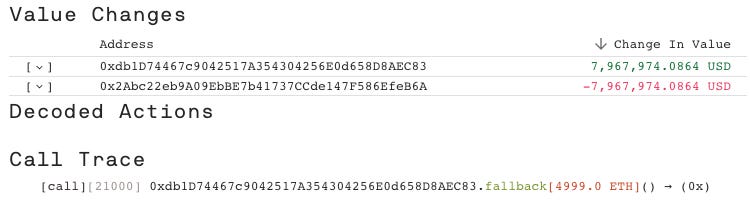
On September 24th, the Huobi Global exploit on the Ethereum Mainnet resulted in a $8 million loss due to the compromise of private keys. The attacker executed the attack in a single transaction by sending 4,999 ETH to a malicious contract. The attacker then created a second malicious contract and transferred 1,001 ETH to this new contract. Huobi has since confirmed that they have identified the attacker and has extended an offer of a 5% white hat bounty reward if the funds are returned to the exchange.