
The blockchain infrastructure landscape faces a unique security challenge: failures don't just impact individual protocols; they cascade across entire ecosystems. When you're building Layer 2 solutions, cross-chain bridges, or tokenization platforms, every smart contract becomes a potential single point of failure for the projects and users who depend on your infrastructure.
Traditional security approaches weren't designed for this complexity. Point-in-time audits can't keep pace with rapid infrastructure development cycles, and manual security processes don't scale when you're responsible for establishing standards across an entire ecosystem of builders. Infrastructure exploits regularly result in eight and nine-figure losses that destroy not just individual projects, but entire communities of dependent protocols.
The most successful infrastructure providers are recognizing a fundamental shift: security must be built into the development process itself, embedded in every commit, and scaled across every project that builds on their foundation. This isn't just about finding more bugs; it's about creating security frameworks that grow stronger with each iteration.
Lumia is a native blockchain focused on real-world asset tokenization, operating across Turkey, UAE, and Bahrain. As a Layer 2 infrastructure provider, Lumia manages complex smart contract systems handling cross-chain transactions and asset tokenization at scale.
Their infrastructure underpins RWA tokenization, liquidity routing, and staking mechanisms, with contracts often having direct custody over user assets. The protocol specializes in bringing traditional financial assets on-chain through sophisticated architecture including diamond proxy patterns and cross-protocol integrations.
With six full-time Solidity developers, Lumia's technical complexity requires security measures that scale with their development velocity. They employ a layered security approach combining proactive static analysis, runtime monitoring, and defense-in-depth protocols to shift security into the earliest phases of development.
Lumia faced a dual challenge that many infrastructure providers encounter. First, they needed comprehensive security for their own protocol development: frequent feature changes made iterative external auditing expensive and time-consuming. Second, as an ecosystem builder, they wanted to establish security standards for projects building on their infrastructure.
The team needed tools that could handle their specific technical challenges:
Lumia implemented Olympix's comprehensive security suite, focusing on building internal security capabilities while establishing a framework they could extend to their ecosystem partners.
The static analyzer immediately proved valuable during their custom demo on a stablecoin project. It identified several critical patterns, including checks-effects-interactions violations in diamond proxy functions and unused return values from critical operations.
The tool achieved approximately 75% accuracy compared to 15% for typical open-source alternatives, with significantly lower noise levels that made review efficient. As one team member noted: "This tool was one of the best, I would say."
Beyond automated tools, Olympix provided expert-led audit preparation, including configuration file review and external integration analysis with protocols like Curve and Superform.
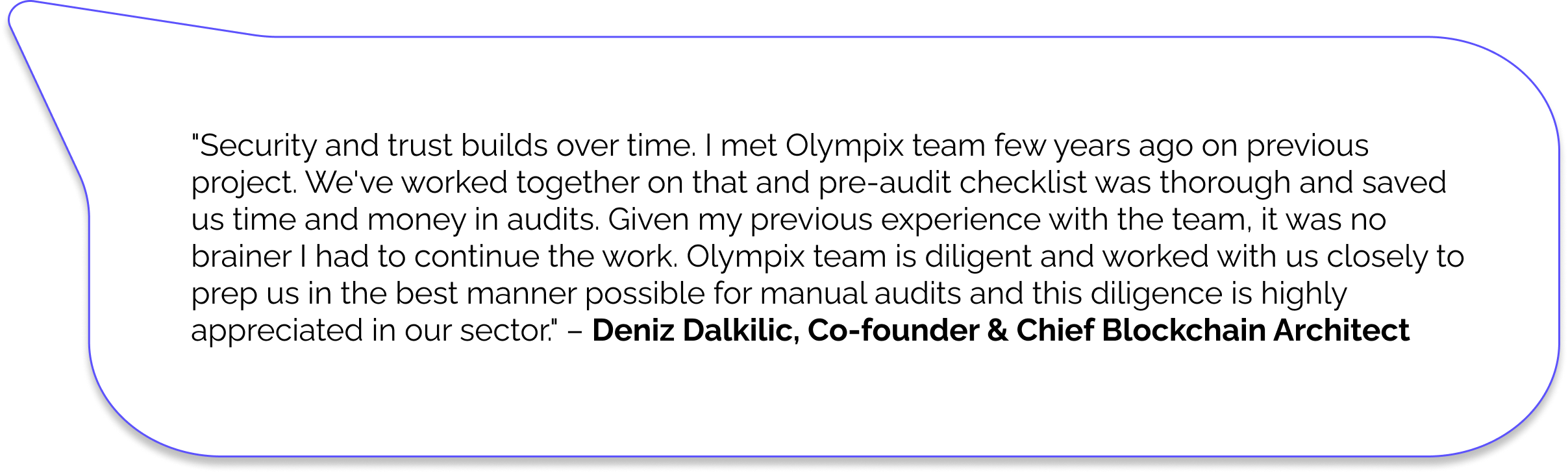
The collaboration extended beyond just tooling. As the Lumia team explained:
The team found the CLI integration straightforward and effective for their development workflow, allowing them to incorporate security validation directly into their existing processes without disrupting productivity.
The command-line interface aligned with their preferred development practices, enabling developers to run security analysis as part of their regular code review process rather than requiring separate tools or workflows.
This approach meant security checks could be integrated into existing CI/CD pipelines and development scripts, making security validation as routine as running tests or linting code. The streamlined integration reduced friction for adoption across the team while ensuring consistent security practices regardless of individual developer preferences or experience levels.
Lumia shifted from project-by-project security spending to scalable infrastructure investment, gaining:
As an infrastructure provider, Lumia leveraged their security investment to strengthen their entire ecosystem:
Automation delivered immediate productivity gains across multiple dimensions:
The combined impact represents a fundamental shift from reactive security spending to proactive security infrastructure, enabling Lumia to scale their development velocity while maintaining rigorous security standards across their expanding ecosystem.
The impact of this comprehensive approach extends far beyond individual tool implementations. As Deniz Dalkilic, Lumia's Co-founder & Chief Blockchain Architect, reflects: "As an engineering team, we now go into audits — and ultimately ship to mainnet — with far greater confidence, knowing our code has been through multiple layers of review: static analysis, manual inspection, and direct one-on-one sessions with the Olympix team. We understand that security is inherently challenging and no system can be 100% foolproof, but what truly matters is the level of precaution and proactive effort you invest.
Olympix has embedded this mindset into our workflow, pushing us to think 'security-first' at every stage. Their continuous, contextual feedback has caught edge-case vulnerabilities early, reduced our mean-time-to-remediate, and reinforced the importance of manual audits as a permanent fixture in our development pipeline. This shift has not only improved our code quality but has also strengthened the trust we can offer to partners and institutions relying on Lumia's infrastructure."
Lumia transformed their approach from reactive manual security processes to proactive automated validation integrated into their development workflow. They didn't just solve their own security challenges; they created a framework that elevates security standards across their entire ecosystem.
Their implementation demonstrates how infrastructure providers can leverage comprehensive security tooling to simultaneously strengthen their own protocols while establishing best practices for the projects building on their platforms.
The result: a scalable security framework that grows with development velocity, reduces audit costs, and creates ecosystem-wide security standards that benefit everyone building on Lumia's infrastructure.
Explore Olympix's suite of smart contract tools and learn more about the Olympix-led automated smart contract audit process. Empower your team to take control of your smart contract security from the start. Book a free demo!