
LLMs Can't Audit Your Smart Contracts: Why Probabilistic AI Falls Short of Verifiable Security
AI-powered smart contract auditors are proliferating fast, but probabilistic tools cannot provide the reproducible evidence that on-chain finance demands, which is why deterministic security is the standard that counts.

The pitch is compelling. Drop your Solidity code into an AI-powered auditor, wait a few minutes, and receive a list of vulnerabilities ranked by severity. No scheduling delays, no five-figure invoices, no waiting weeks for an audit firm's calendar to open up. AI-powered smart contract security tools have attracted real investment and real users, and the marketing is persuasive.
The problem is that the underlying technology cannot do what the marketing claims.
For where AI does help, see our inside look at AI smart contract security tools.
Smart contracts execute financial logic autonomously, hold billions of dollars in value, and cannot be patched once deployed. In that environment, "probably secure" and "secure" are not the same thing. They are not even in the same category. Probabilistic systems produce probabilistic results, and probabilistic results are not a standard of correctness for on-chain finance. This is not a nuanced critique but a fundamental property of how these tools work, and the industry needs to be clearer about it.
90% of exploited smart contracts were audited at least once, and they were still hacked.
What LLM-Based Auditors Actually Do
Large language models are trained on code. They learn patterns: what reentrancy looks like, how integer overflow typically manifests, the common signatures of access control bugs. When you submit a smart contract for analysis, the model compares your code against those patterns and generates a probabilistic output: a set of findings that match patterns it has seen before, ranked by some confidence threshold.
This is pattern recognition, not proof. The model does not execute your code. It does not explore all possible execution paths. It does not verify that invariants hold across every possible input. It generates text that describes vulnerabilities it thinks might exist, based on statistical similarity to training data.
The research community has studied this carefully. Even the most optimistic academic benchmarks for LLM-based vulnerability detection land around 60% accuracy when ensemble methods are used, meaning multiple models vote on findings to improve the signal. That is a 40% gap between what the tool reports and what is actually there. In traditional software, a 40% error rate is embarrassing. In smart contracts securing hundreds of millions of dollars, it is catastrophic.
Worse, the accuracy figure applies only to known vulnerability classes. For novel attack vectors (logic bugs, economic exploits, protocol-specific assumptions that no training dataset has ever seen), LLMs have no meaningful signal. A model trained on historical vulnerabilities cannot detect a vulnerability pattern that does not exist in its training data.
A model trained on historical vulnerabilities cannot detect a vulnerability pattern that does not exist in its training data.
The False Positive Problem Makes Triage Unworkable
There is a second failure mode that rarely appears in the marketing materials for AI audit tools: false positives at scale.
When LLMs are tuned to catch more bugs, they generate more noise. Increasing the model's sensitivity by lowering the threshold for flagging potential issues directly increases the rate of false positives. This is not a fixable tuning parameter; it is a mathematical tradeoff baked into probabilistic systems.
For a development team, this creates a triaging burden that erodes trust in the tool. Engineers spend hours investigating alerts that are not real vulnerabilities. Over time, the instinct is to discount the tool's output, which is exactly the wrong behavior in a domain where real findings carry enormous stakes. A security tool that produces noisy output trains its users to ignore security.
Deterministic tools do not have this property. A finding from a symbolic execution engine is reproducible, traceable, and falsifiable. Either the execution path exists and the bug is real, or it does not and the tool is wrong in a diagnosable way.
Context-Dependent Logic Is Where Exploits Live
The vulnerabilities that drain protocols are rarely the textbook bugs that appear in training datasets. They are logic errors that are only exploitable given the specific economic conditions, access patterns, and state transitions of a particular protocol.
Consider the $121M Balancer exploit in 2025. The vulnerability was not a classic reentrancy attack that any trained model would flag. It required understanding the protocol's specific invariants, the conditions under which those invariants could be violated, and the economic path an attacker would take to profit from the violation. That is not pattern matching. That is formal reasoning about protocol-specific state.
LLMs have no mechanism for this kind of reasoning. They cannot model attacker behavior. They cannot explore the economic logic of a flash loan attack against a specific AMM implementation. They cannot search your protocol's reachable states for the execution that breaks its assumptions. They can only ask: does this code look like code that has had a vulnerability before?
The answer to that question is almost always yes, which is how you end up with both 40% false negative rates and an overwhelming number of false positives simultaneously.
$247M in smart contract losses that Olympix's deterministic engine would have prevented, covering 49 of the 50 in-scope 2025 EVM exploits.
The Standard That Actually Matters: Verifiable, Deterministic, Reproducible
On-chain finance is a zero-failure domain. Contracts execute autonomously with no human in the loop. There is no rollback, no customer support escalation, no patch deployment at 2am. When the code runs, the money moves. The security standard that matches this reality is evidence you can reproduce, not "probably correct."
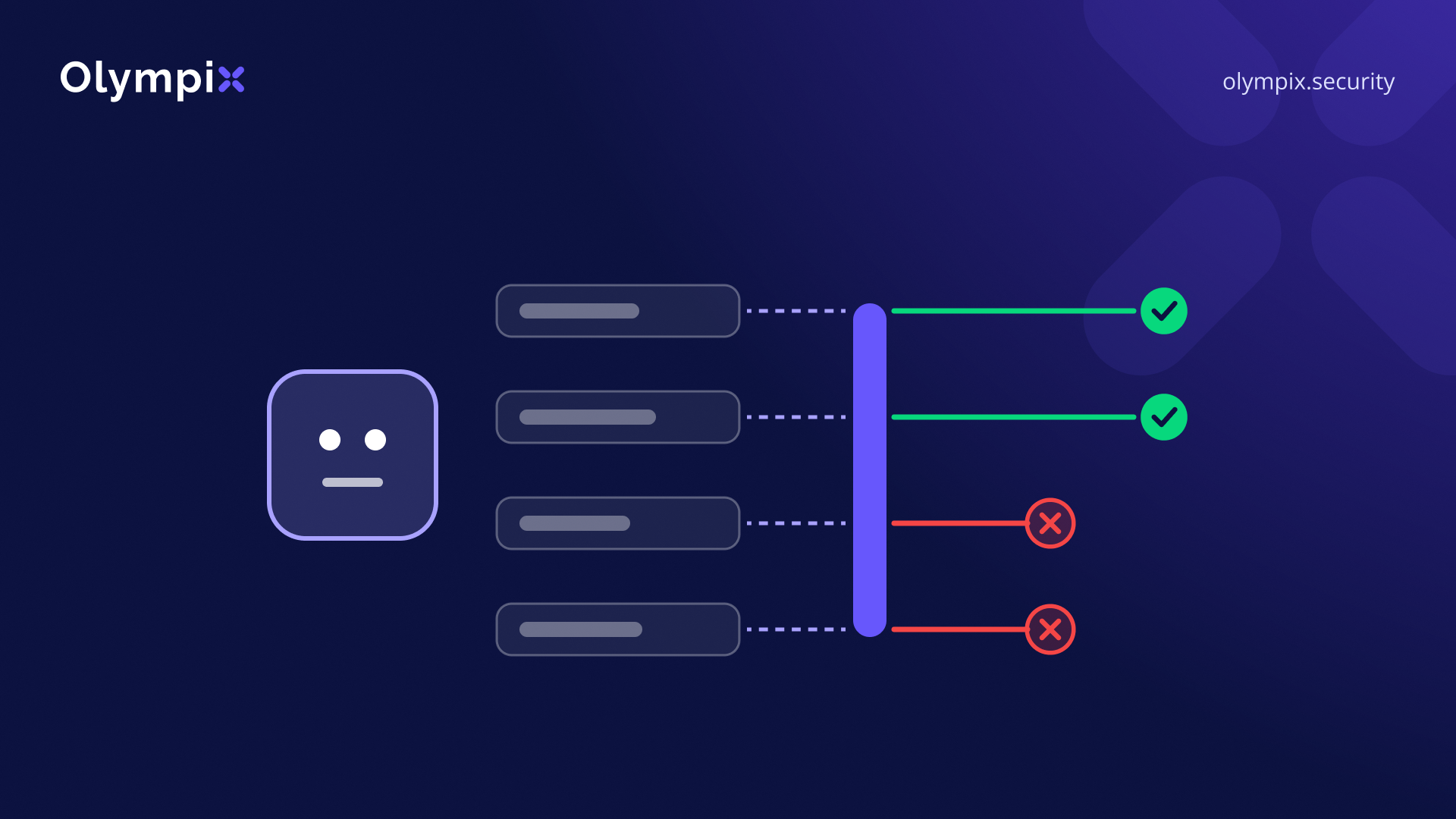
Deterministic analysis has a specific technical meaning. The tool explores a contract's execution paths, and when an exploitable state is reachable it produces a concrete counterexample, the exact sequence of calls that reaches that state, which any engineer can replay. That counterexample is the finding, and it is reproducible and verifiable in a way a probability score never is.
The distinction matters across two axes:

Using Deterministic Security Tools: Where Olympix Fits
Olympix is built on a proprietary deterministic architecture combining intermediate representation, a custom compiler, symbolic execution, and purpose-built vulnerability detectors. It is not an LLM wrapper. It does not produce probabilistic findings. Its results are reproducible, mapped to real-world exploit classes, and generated with near-zero noise.
The Olympix stack covers the full development lifecycle, from the first commit through audit preparation. Each layer addresses a specific failure mode that probabilistic tools cannot touch:
- Static Analysis surfaces known vulnerability patterns as code is written rather than after the fact, with deterministic detector findings mapped to real exploit classes.
- Unit Test Generation produces comprehensive coverage automatically, with measurable line and branch percentages, so coverage gaps are quantified rather than guessed.
- Mutation Testing validates whether existing tests actually detect faulty logic, or only exercise the happy path. A green test suite is not the same as a secure codebase.
- Fuzzing and Formal Verification explore execution paths to infer and validate invariants, generating reproducible exploit test cases for the highest-impact paths.
- BugPoCer, the audit preparation layer, automatically generates proof-of-concept exploits for confirmed findings. Teams go into external review knowing exactly what is real, not what is probable.
The output of this stack is not a list of things that might be wrong. It is a verifiable evidence trail: vulnerabilities introduced, detected, fixed, and re-verified continuously in CI/CD. Security policies are enforced automatically within deployment workflows.
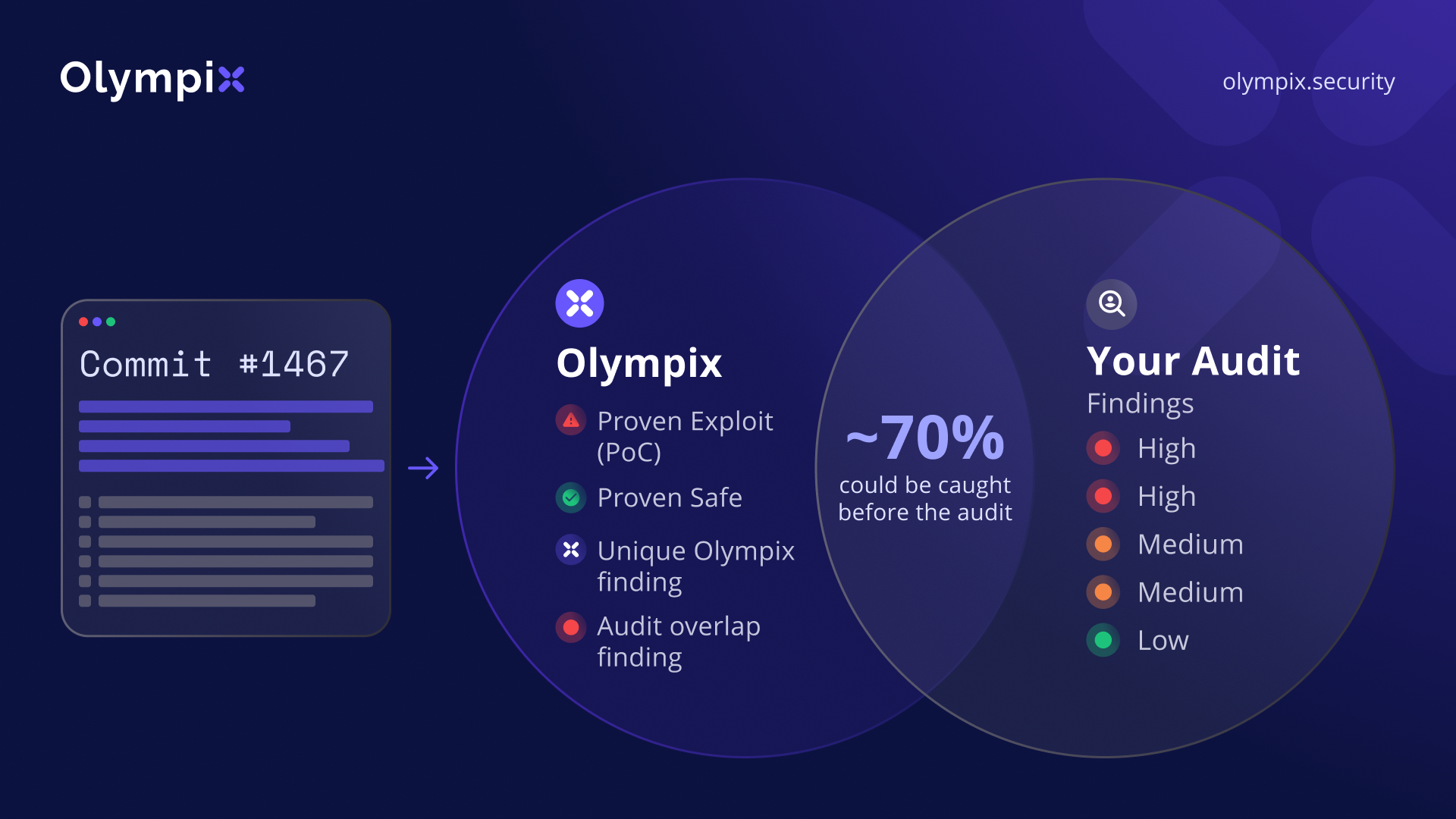
Teams using Olympix find an average of 70% of the same findings a typical external audit surfaces, before the audit begins. That translates directly to fewer audit rounds, lower audit spend, and faster time to mainnet. The contrast with LLM-based tools is one of category rather than degree, since LLMs produce text that describes probable issues while Olympix produces reproducible evidence.
LLMs describe issues that might be real. Olympix hands you the counterexample that shows which ones are.
The Institutional Standard Is Shifting
Protocols securing real capital are beginning to make this distinction explicitly. Circle, Uniswap, Li.Fi, Sky Mavis, and Crossmint, all teams operating mainnet systems with real economic risk, have adopted Olympix as a core part of their security infrastructure.
The shift is happening because the cost of getting it wrong is now visible at scale. In 2025, smart contract exploits totaled hundreds of millions of dollars across protocols that had passed traditional audits. The audit-only model was insufficient. On-chain monitoring caught exploits after the funds were already gone. And AI-powered scanners flagged thousands of potential issues while missing the ones that mattered.
The protocols building for longevity are treating security as infrastructure, something verified before deployment rather than investigated after failure. That requires deterministic tools with verifiable outputs, running continuously throughout development, not probabilistic assessments applied once at the end of a project.
The Bottom Line
AI has a role in smart contract development. It can assist with code review, help generate documentation, and accelerate routine tasks. But AI cannot provide the deterministic evidence that on-chain financial systems require. Probabilistic outputs are not a substitute for a reproducible counterexample, and no amount of ensemble voting or fine-tuning changes the fundamental property of what LLMs produce.
The bar for security in on-chain finance is not "this code looks safe." It is "every exploitable path we found came with a reproducible counterexample, and each one was fixed and re-verified." Meeting that bar requires deterministic tools built on formal methods, tools that explore execution paths, validate invariants, and produce reproducible results that can be verified by any engineer on your team.
When code becomes capital, correctness becomes non-negotiable.
Replace probabilistic guesses with verifiable security. See how Olympix integrates into your development workflow from first commit to pre-audit. Get started with Olympix
More from the blog
See every article →




See what Olympix finds on your own code
Send us a repo that's already been audited, and we'll run Olympix at the same commit and show you what comes back.