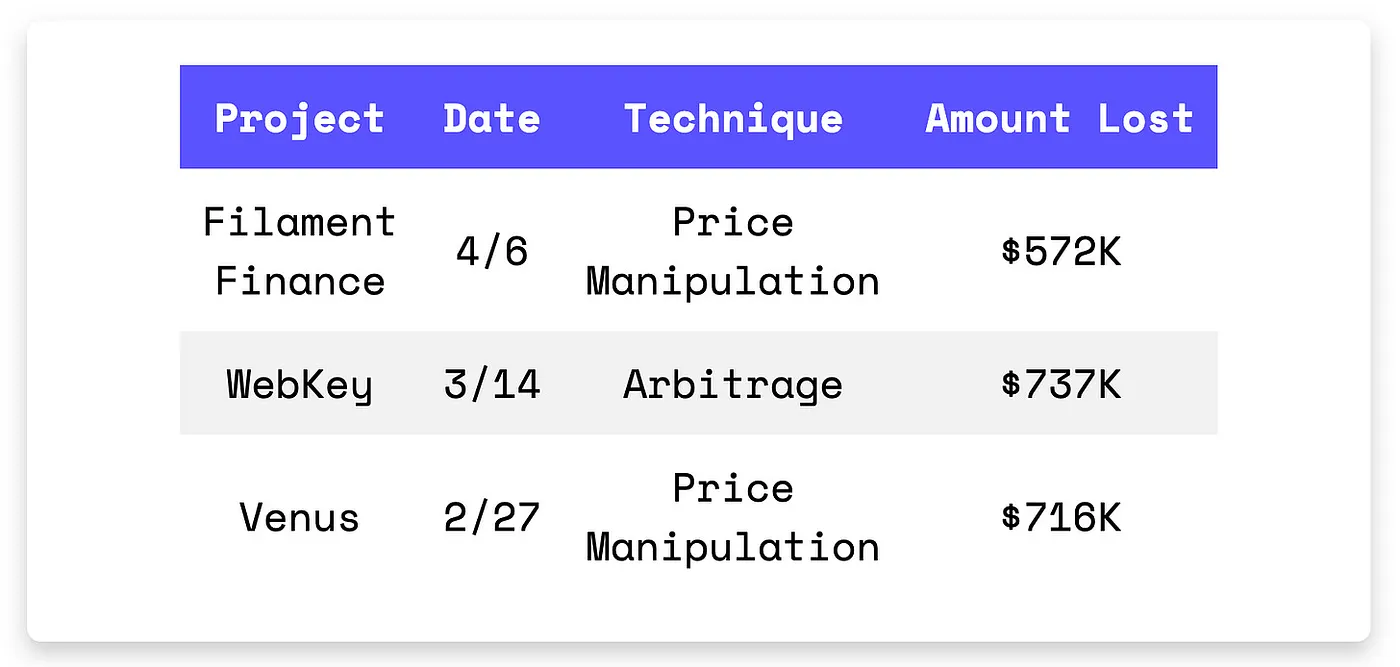
Filament, WebKey, Venus Drained for $2M: Price Oracles, Fixed Params, and Flash Loans Abused
Filament lost $572K on Sei to a leveraged position attack via fake orders. WebKey hardcoded a cheap buy price, costing $737K. Venus was drained for $716K on zkSync after a USDM donation trick inflated its exchange rate. All three show how minor config slips become major exits.
In Brief
Filament Finance lost $572K to price manipulation on Sei.
WebKey was targeted in a $737K arbitrage attack.
Venus suffered a $716K loss due to inflated exchange rates.
Hacks Analysis
Filament Finance | Amount Lost: $572K
On April 6, the Filament Finance exploit on the Sei network resulted in a $572K loss due to a price manipulation attack. The attacker set up multiple contracts to place large, fake orders and artificially inflated the token price. The attacker then created leveraged positions using minimal collateral. Finally, the attacker placed fake sell orders to crash the prices, leaving their previous leveraged positions undercollateralized. This triggered self-liquidation at favorable rates and allowed the attacker to make a profit.
Press enter or click to view image in full size
One of Multiple Transactions (Sei): 0x3bc6f9a1d51e1afa57a25de570c3e628de3efe56e4765d2c7d2769f049b2e9dc
WebKey | Amount Lost: $737K
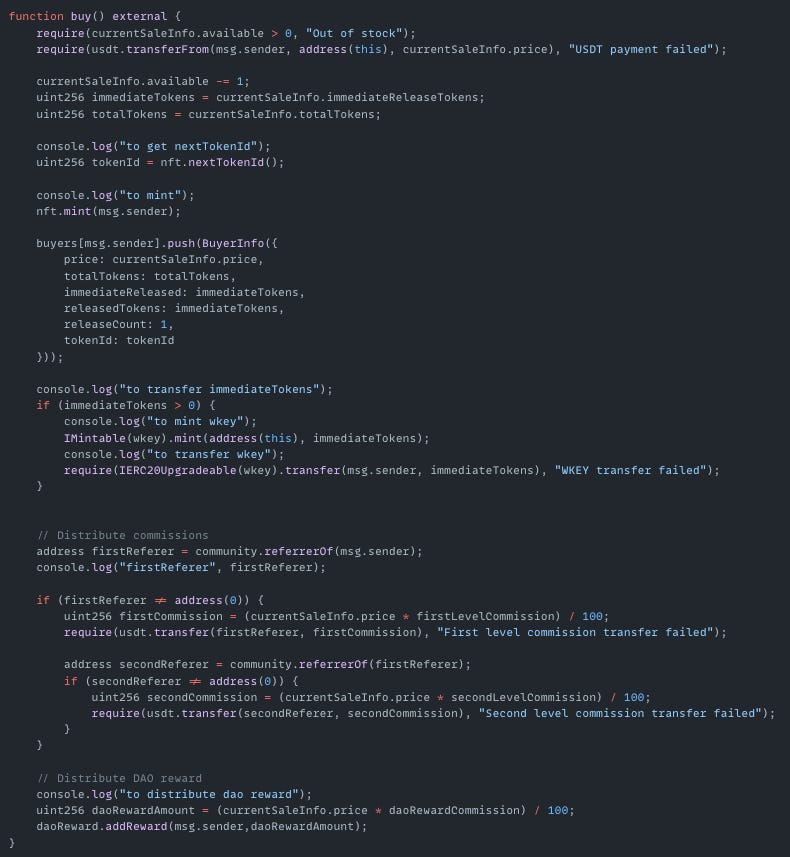
On March 14, the WebKey exploit on the BSC resulted in a $737K loss. The root cause of the exploit was the misconfigured currentSaleInfo parameter in the buy() function, which had been set by the WebKey operator earlier. The currentSaleInfo parameter contained a fixed low _price value, which enabled the attacker to buy wkeyDao tokens at artificially low prices and sell at higher market prices on DEXs.
Press enter or click to view image in full size
Exploited Contract (on BSC): 0xc39c54868a4f842b02a99339f4a57a44efc310b8
On February 27, the Venus exploit on zkSync resulted in a $716K loss due to a price manipulation attack. The attacker first borrowed 2,100 WETH flash loan from Aave and deposited it as collateral on Venus to borrow 466,000 wUSDM. The attacker then transferred wUSDM to a second wallet, used it as collateral, and repeated to borrow an additional 2,167,431 wUSDM. Lastly, the attacker donated 439,560.48 USDM to the wUSDM contract and inflated the exchange rate from 1.067 to 1.7641, which allowed the attacker to make a profit.
Press enter or click to view image in full size
Transaction (on zkSync): 0x35a0172fb6bd450ceb29aa67dc85221826dfd0b7528375400b4ccf15c1eed0d8
What’s a Rich Text element?
The rich text element allows you to create and format headings, paragraphs, blockquotes, images, and video all in one place instead of having to add and format them individually. Just double-click and easily create content.
A rich text element can be used with static or dynamic content. For static content, just drop it into any page and begin editing. For dynamic content, add a rich text field to any collection and then connect a rich text element to that field in the settings panel. Voila!
Headings, paragraphs, blockquotes, figures, images, and figure captions can all be styled after a class is added to the rich text element using the "When inside of" nested selector system.
Follow-up: Conduct a follow-up review to ensure that the remediation steps were effective and that the smart contract is now secure.
In Brief
Remitano suffered a $2.7M loss due to a private key compromise.
GAMBL’s recommendation system was exploited.
DAppSocial lost $530K due to a logic vulnerability.
Rocketswap’s private keys were inadvertently deployed on the server.
Hacks
Hacks Analysis
Huobi | Amount Lost: $8M
On September 24th, the Huobi Global exploit on the Ethereum Mainnet resulted in a $8 million loss due to the compromise of private keys. The attacker executed the attack in a single transaction by sending 4,999 ETH to a malicious contract. The attacker then created a second malicious contract and transferred 1,001 ETH to this new contract. Huobi has since confirmed that they have identified the attacker and has extended an offer of a 5% white hat bounty reward if the funds are returned to the exchange.