
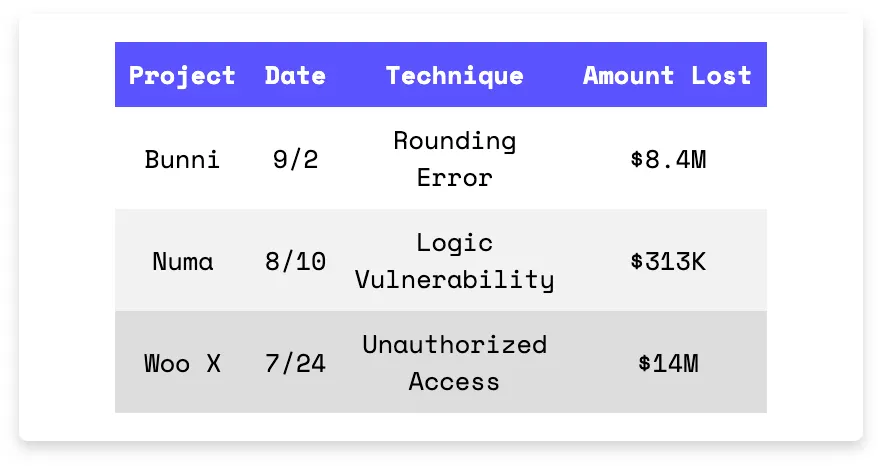
Bunni’s $8.4M rounding exploit, Numa’s $313K synthetic price attack, and Woo X’s $14M cloud compromise all point to the same truth: the weakest link in your system is where trust assumptions go unexamined. From wei-level math to DevSec hygiene, small oversights compound into major losses.
On September 2nd, the Bunni exploit on Ethereum mainnet resulted in an $8.4M loss. The root cause was that the withdraw() function used mulDiv (rounds down) instead of mulDivUp in newBalance = balance — balance.mulDiv(shares, totalSupply). The attacker borrowed 3M USDT to buy USDC, leaving 28 wei of USDC in the pool. They then burned tiny amounts of liquidity 44 times. Each burn removed extra USDC due to rounding down, while 4 wei remained in the pool. This sequence drove the pool into low liquidity and artificially inflated the USDC price, allowing the attacker to make a profit.

Exploited Contract: 0x000000000049c7bcbca294e63567b4d21eb765f1
Transaction: 0x1c27c4d625429acfc0f97e466eda725fd09ebdc77550e529ba4cbdbc33beb97b
On August 10th, the Numa exploit on Sonic resulted in a $313K loss. The root cause was a logic flaw that let the attacker manipulate cNuma prices by inflating synthValueInEth and forcing liquidations. The NumaVault contract priced cNuma using numaToToken, which was tied to (EthBalance − synthValueInEth). By minting 3.08 nuBTC, the attacker raised synthValueInEth from 160k to 1.35M. This drop in (EthBalance − synthValueInEth) pushed cNuma’s price down from 7.579 to 2.115. Many accounts then appeared under-collateralized. The attacker called the standard liquidateBorrow() function, repaid liquidated accounts’ debt, and received cNuma at the deflated price.


cToken.sol (on Sonic): 0x16d4b53de6aba4b68480c7a3b6711df25fcb12d7
NumaVault.sol: 0xde76288c3b977776400fe44fe851bbe2313f1806
VaultManager.sol: 0xf8021c37b20a0c5bad67b67cc79dd98e7ef82f6b
Transaction: 0x56abdbc84232658617853f233f52e6b4c855129c7ab163a588c2bac62ea304080x56abdbc84232658617853f233f52e6b4c855129c7ab163a588c2bac62ea30408
On July 24th, the Woo X exploit resulted in a $14M loss due to unauthorized access to 9 user accounts. The root cause was that a Woo X developer was tricked into installing a malware which gave the attacker access to WOO’s cloud systems. The attacker updated the login details for 9 accounts and withdrew funds in BTC, ETH, BNB, and Arbitrum. The Woo X team paused all withdrawals and reimbursed the affected users.

Transaction (on BTC): 24f8b5824c2c7ff637e2a2a32b5dc290302b63d0fcd44886f833a2f52ba7114f