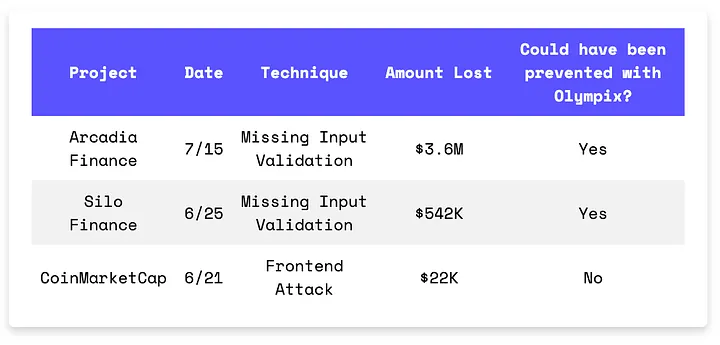
Arcadia Finance, Silo Finance, and CoinMarketCap Breached for $4.1M via Input Validation Failures and Front-End Exposure
Arcadia lost $3.6M after its rebalance() function failed to validate swapData. Silo Finance was drained of $542K when _fillQuote() trusted calldata pointing to silo.borrow(). CoinMarketCap suffered a $22K front-end exploit via a malicious image triggering unauthorized pop-ups.
In Brief
Arcadia Finance lost $3.6M due to missing input validation in the rebalance() function that allowed an attacker to manipulate swapData.
Silo Finance suffered a $542K loss due to missing validation in the _fillQuote() function.
CoinMarketCap lost $22K due to a front-end attack that triggered pop-ups from a malicious image link.
Hacks Analysis
Arcadia Finance | Amount Lost: $3.6M
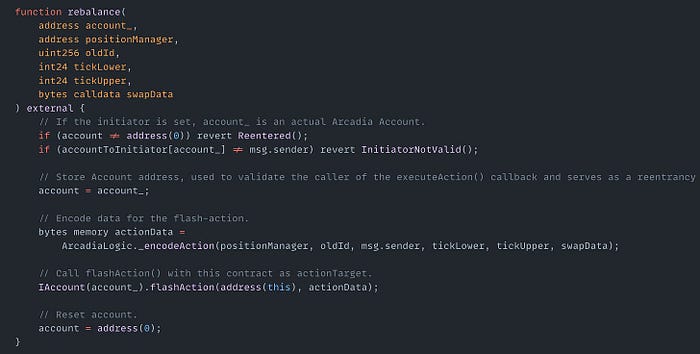
On July 15th, the Arcadia Finance exploit on Base chain resulted in a $3.6M loss. The root cause of the attack was missing input validation in the rebalance() function for the swapData parameter. The attacker initially borrowed 5,623 WETH and 9,968 cbBTC and called the setAssetManager() to get manager permissions. The attacker then minted an LP‑NFT using 1,773 USDC and 0.123 cbBTC and repaid 14.4 cbBTC so the health check would pass. This allowed the attacker to call the rebalance() function with malicious swapData that allowed the withdrawal of liquidity.
Press enter or click to view image in full size
Exploited Contract (on Base): 0xC729213B9b72694F202FeB9cf40FE8ba5F5A4509
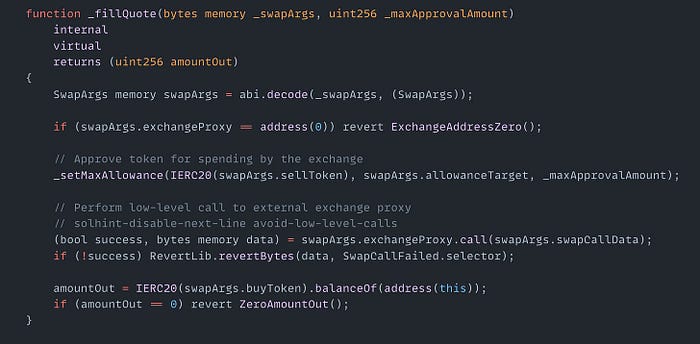
On June 25th, the Silo Finance exploit on Ethereum mainnet resulted in a $542K loss. The root cause of the exploit was missing validation on external call logic. The attacker called the _fillQuote() function with malicious _swapArgs data. This data pointed to a legitimate Silo market (WETHSilo) as exchangeProxy and contained calldata for silo.borrow(). The contract executed this borrowing call, mistakenly assuming it was a swap. The attacker set their own wallet as the receiver in the calldata, redirecting the borrowed ETH and making a profit.
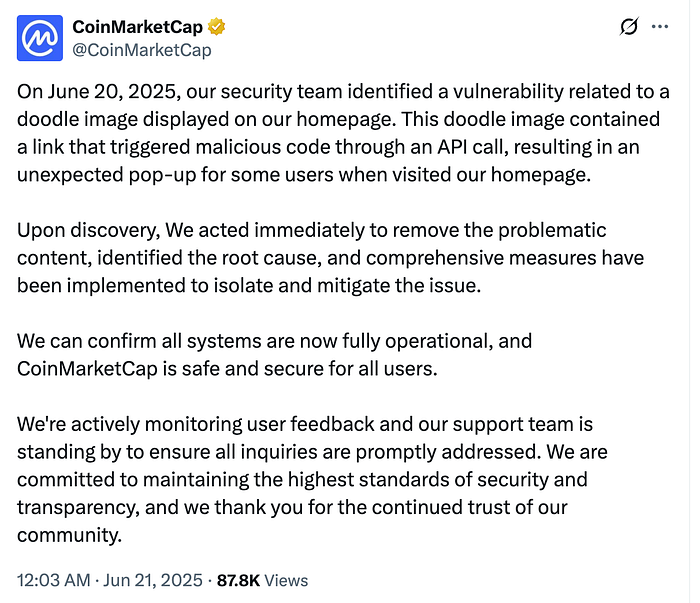
On June 20th, the CoinMarketCap exploit resulted in a $22K loss due to a front-end related attack. The CoinMarketCap team confirmed that an image on their website included a link that triggered malicious code via an API call. As a result, some users experienced unexpected pop-ups when visiting the site. The CoinMarketCap team removed the content and confirmed implementing safeguards.
Press enter or click to view image in full size
What’s a Rich Text element?
The rich text element allows you to create and format headings, paragraphs, blockquotes, images, and video all in one place instead of having to add and format them individually. Just double-click and easily create content.
A rich text element can be used with static or dynamic content. For static content, just drop it into any page and begin editing. For dynamic content, add a rich text field to any collection and then connect a rich text element to that field in the settings panel. Voila!
Headings, paragraphs, blockquotes, figures, images, and figure captions can all be styled after a class is added to the rich text element using the "When inside of" nested selector system.
Follow-up: Conduct a follow-up review to ensure that the remediation steps were effective and that the smart contract is now secure.
In Brief
Remitano suffered a $2.7M loss due to a private key compromise.
GAMBL’s recommendation system was exploited.
DAppSocial lost $530K due to a logic vulnerability.
Rocketswap’s private keys were inadvertently deployed on the server.
Hacks
Hacks Analysis
Huobi | Amount Lost: $8M
On September 24th, the Huobi Global exploit on the Ethereum Mainnet resulted in a $8 million loss due to the compromise of private keys. The attacker executed the attack in a single transaction by sending 4,999 ETH to a malicious contract. The attacker then created a second malicious contract and transferred 1,001 ETH to this new contract. Huobi has since confirmed that they have identified the attacker and has extended an offer of a 5% white hat bounty reward if the funds are returned to the exchange.